


A Sneak-Peek at the Setting

Here’s a little secret:
Boston wasn’t the original setting of The Boston Revolutionary Art and Teacup Society.
At first, it was going to take place in Paris, and the Rats’ hideout was going to be in the catacombs. But as I was writing, it became increasingly difficult to write in a setting where I didn’t know the language and I was unfamiliar with the culture.
So, then the setting changed to London, England.
I encountered a few of the same issues. I have never been to London (though it’s #1 on my bucket list), and it was difficult to write about locations I’ve never seen in person and capture the culture of a country I’ve never experienced myself.
Then I knew it needed to take place in the United States.
But I knew the atmosphere of the setting needed to be old, with cobblestone streets and historic architecture. And that’s when I knew it needed to be in New England.
At first, I was going to have the setting take place in a fictional city on the East Coast. I had come up with names such as “Roark, Connecticut” (named after Howard Roark from The Fountainhead by Ayn Rand). But something about it just wasn’t working in my head.
Then I started thinking about the themes of my novel, how a revolution against cultural norms and conventional standards, and those who enforce them, was the core of the Society itself. And then I thought about how the American Revolution began because of…tea.
Yes, what a very Boston-Rat way to start a war.
This is why, when the Boston Rats recite their anthem at every nightly tea, they throw their tea behind them: a homage to the Boston Tea Party. It’s their way of saying, To hell with convention and the authorities who enforce it! It is how they declare their individuality—or independence, so to speak.
These parallels are why I decided: Yes, Boston is the perfect location for this novel to take place.
Once my first draft was complete, my husband, Jordan, suggested we take a trip to Boston so I could see the setting of my novel in person. So, off to Boston we went in the summer of 2022.
So, here we were, in one of the most historic cities in the United States, and I was taking photos of…manholes.
Yes, dirty, ugly, mundane manholes.
And what’s more, I was excited to see them.
Believe it or not, when I saw a manhole with the full words “Boston Sewer” on it, I literally squealed.
Yes, squealed.
Over a manhole.
And, obviously, I needed to take a picture.
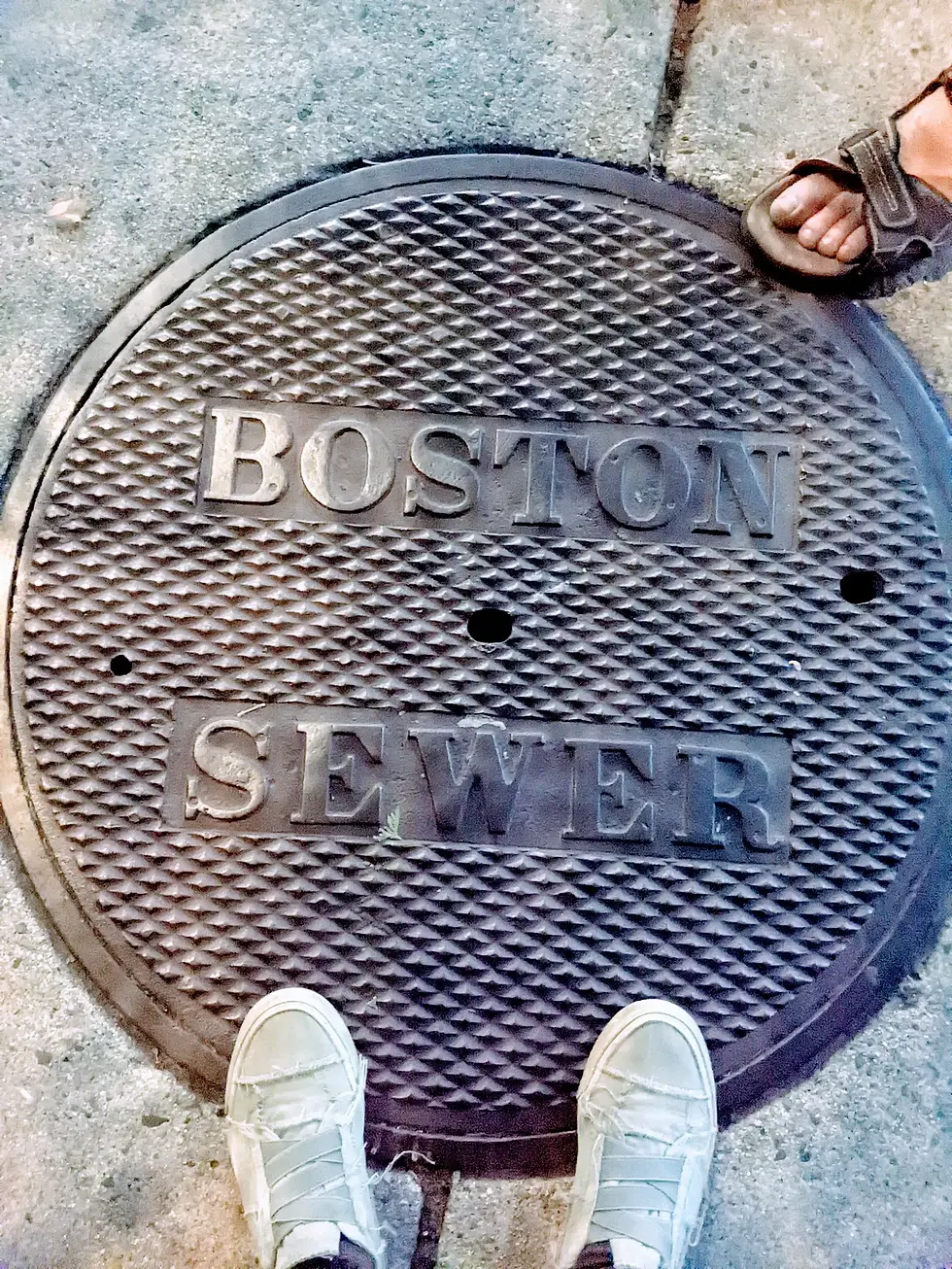
(Yes, those are my shoes. And Jordan’s sandal at the top.)
So, yeah. Manholes.
You may be wondering: Why manholes? What’s so special about them?
Allow me to enlighten you.
The Boston Rats live in an underground hideout they call “The Fortress”—a massive limestone canyon-like formation caused by erosion from an underground river uncharted by any cartographer throughout history. It’s an eighth Natural Wonder of the World that no one knows about except for the Boston Rats themselves. And over the course of years, the Society’s members created rooms, furniture, and plumbing so that this underground hideout could actually be lived in.
And the way the Boston Rats access the Fortress without being seen by civilians is by swiftly escaping down manholes.
When we first encounter the Boston Rats, Camilla is smoking a cigarette in front of the Green Dragon Tavern on Creek Square. It’s midnight, so the alleyway is empty.

And then here comes Sparrow and Rowan, who are in the midst of an odd conversation, while dressed in Victorian costumes and masquerade masks. Camilla watches in fascination as they lift the lid of a manhole, climb down, and top the lid behind them.
And here is a picture of me with the infamous manhole in this exact location.
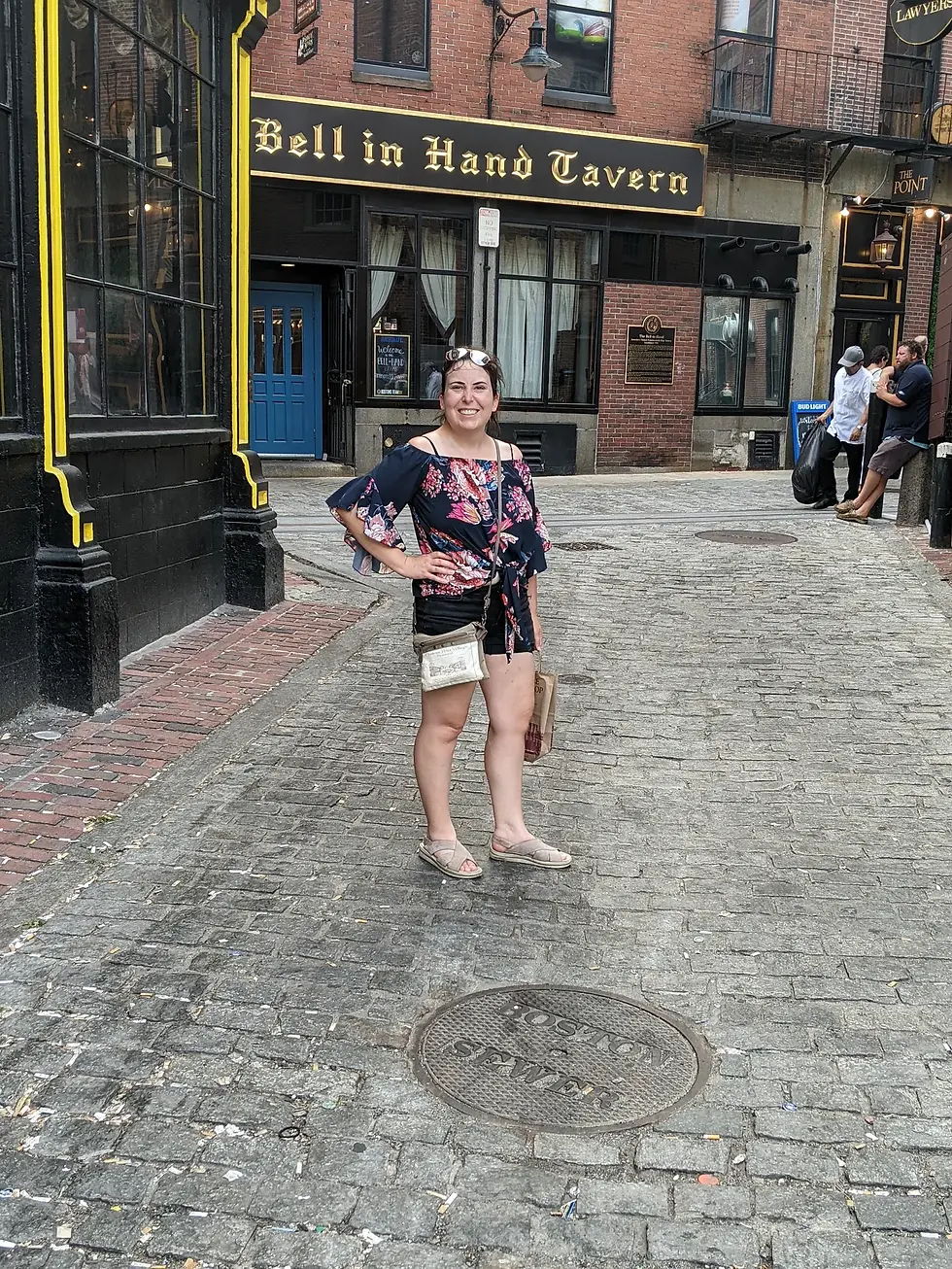
Yes, there actually is a real-life manhole in that alleyway. In fact, The Boston Revolutionary Art and Teacup Society is packed with instances of manholes that exist in real life in those exact locations.
(Except when I needed to make them up. Creative license, and all that.)
I imagine I must have received some odd looks from passersby, wondering why I could possibly be so excited to have my picture taken with a manhole. It is my hope that once you’ve read my novel, you will be just as excited to see a manhole in a real-life Boston location I’ve described. And outside of Boston, I hope that every time you see one, you will see it with new eyes.
And people will wonder why you’re smiling at a manhole.
Updates
Writing
In January, I began to prioritize writing my next novel. This is my least favorite part of the writing process: The time between completing a novel that I’m proud of and starting the first draft of a new one. During this time, I’ve usually been taking a break from writing, and so once I begin another project, I’m out of practice and my writing skills are a bit rusty. As a result, I loathe every sentence I write. But I must push through it, because in order for my writing to improve again, I will need to . . . write.
Shocking, I know.
First drafts are supposed to be terrible. But someone needs to send that memo to my brain.
In other news, I’m very excited about this new novel, and I hope to tell you more about it in a future blog post.
Submissions
In January, I also took the time to comb through a novella (a ~30,000 word book) that I wrote over ten years ago (it amazes me that it’s been that long). Since it was just sitting there in one of my numerous writing folders, I figured I might as well give it a shot at publication.
So, I’ve been submitting it to several novella contests and small presses with vague hope. In general, novellas are more difficult to publish because most publishers only accept full book-length novels (50,000+ words). Only a small percentage of publishers (and even fewer agents) accept novellas, which means my options are limited.
This means that if I haven’t received an acceptance when the manuscript is in novella form, I may try to expand it by 20,000+ words and turn it into a full-length novel. We’ll see how it goes.
How You Can Support Me
If you haven’t yet put “The Boston Revolutionary Art and Teacup Society” on your Want To Read list on Goodreads, you can do so here.
Browse my Pinterest boards to see how I imagined my characters, their costumes, and the setting (the Fortress). I’ve added some new material this month, so go check it out! Give me a follow, if you like.
Follow me on Facebook and Instagram and interact with my content :)
Thank you for reading!
Tirra Lirra,


Comments